Friday, 10 August 2012

Goodbye to an Old Friend

When me moved to North Wales almost 7 years ago, we bought, along with the house and holiday cottage, a 1964 Fordson Super Dexta tractor and Amtex topper which the previous owners had used to cut the grass in the one-acre field.  We also inherited a finger-mower and lots of spares and maintenance kit for the tractor.

We (that is, I) really enjoyed having the tractor.  It was well used in the early days and has always been a great attraction for the children and children-at-heart of our family.  It has survived the last two cold winters, wrapped up in old quilts in the open-sided post-barn to prevent the block from freezing and cracking.  With just the occasional oil change, greasing and battery-charging, it never failed to start.

But the one-acre field has been developing.  From our second year here, we have been planting trees and hedges to divide the space into a number of different gardening spaces.  We have dug 5 large beds to grow flowers, fruit and vegetables.  This year we have had a large area devoted to annual meadow flowers and grasses.  So the tractor, with its towed 5-feet wide cutter, has become ever less useful, just not nimble enough to cut around and between all these elements.  Grass cutting is now done on a second-hand ride-on mower picked up on Ebay.

So when our trusty builder, Gareth, indicated an interest in buying the tractor to restore, we reluctantly agreed to say goodbye.  Although I am averse to de-stocking on this scale, it obviously made sense.  And now I have lots of space in the barn to think about!

So last weekend we said goodbye, and hope to see the Super Dexta again in its pomp at future agricultural shows.


Friday, 4 May 2012

Basket case

It's good to go back to school from time to time, to leave one's comfort zone, to meet an expert and try something new.  I signed up a while ago for one of many fascinating courses at the Woodland Skills Centre near our neighbouring village of Bodfari.  We are very fortunate to have this fantastic resource so close.

My two day course offered an introduction to willow basket making and the tutor was the hugely experienced and talented Mandy Coates - see her website here.

We have been growing a small amount of willow at the damper end of our field and I was curious to know whether this might ever provide a source for basket making.  In the event I was amazed how much material goes into quite a small basket, so we've since planted another hundred or so whips to give us a chance of harvesting our own material from next year onwards.

The weaving process was fascinating - and hard on the fingers and thumbs at first.  There's a relaxing, almost hypnotic, aspect to the regular ins and outs of the work, with an occasional abrupt awakening when you realise you've gone wrong.  However, all six of us ended up with surprisingly attractive and useful first-time baskets, thanks to Mandy's gentle and authoritative guidance.  Here's mine - now to fill it!


Monday, 9 April 2012

Water, water, every where

Today it has rained for hours and hours; thankfully now, early evening, it has stopped while there is still some light left in which to appreciate the washed world.

We think about water a lot here, and not just for gardening purposes.  Some years before we purchased this property, it was connected to a mains water supply.  But not directly, as the water pressure from Welsh Water was not sufficient to bring a decent supply all the way up the hill to us.  So, a quarter of a mile from our house in a neighbour's sloping field, 40 vertical metres below us, our pump-house nestles in the roots of an enormous oak tree.  Linked to the storage tank in our loft by some complicated electronics, a powerful pump moves water up from a holding tank as and when required.  At least, that's the theory.  It has been known to go wrong, but we have an excellent 'pump man' who comes to sort it out.  We do, however, feel that we pay three times for our water - once for the metered supply, twice for the electricity to pump it up to us, and thrice for the maintenance of the infrastructure.

So partly to save money, and partly because plants prefer non-chlorinated rainwater, we collect the water that falls from the sky.  When we arrived, we inherited a number of domestic-sized rainwater butts, and we have added to them - a total of ten at the last count, including one on a corner of the new barn:


We also inherited, at the back of the house, a non-domestic tank which holds 2500 litres, taking half the rain which falls on the house.  A long pipe leads from it under our drive to the kitchen garden, and (the tank being significantly higher) provides reasonable pressure for watering in the greenhouse.  This gave me the idea, when we started gardening in the field 5 years ago, of storing the rain water which falls on the 'stable' (the workshop/store).  I bought 2 IBCs, each of 1,000 litres, intending to build a platform to raise them to create some head.  Last month, I decided against the platform and bought instead a submersible pump.  The tanks are now in place, linked to share the modified guttering arrangement, and have taken in a total of 1500 litres in the last 30 hours or so.  Let's call the intervening 5 years the planning period.


We are hoping that this supply will go a long way to protecting us from drought when the scorching summer finally arrives.  Two more IBCs are on order to take the bulk of the water from the different roof elevations of the barn.  Four thousand litres should see us through.


Thursday, 5 April 2012

It's finished (or very, very nearly)

So, here is the new two-part barn:


Very nearly finished, because the galvanised doors have to be painted juniper green at some point to match the cladding of the rest of the structure.  The lower pair are sliders and the higher pair side-hinged, and amazingly everything seems to work well despite the sloping site.  We now know that 80 tons of stone went into levelling the floors - it will be great to have our first level working sites, and under cover, too.

What a lot of stock items I'm going to be able to fit in!

Tuesday, 13 March 2012

Amazing progress

Exactly a week ago this was our view in the field towards Moel Arthur:


And this is what our great team of four erectors from Cerrigydrudion have achieved in just five working days:


It's all the more surprising as the first day was 'just' demolition and the second ended with nothing to show above ground, as the site had been measured and holes dug for the concrete bases which now support the steel posts.  Offsite pre-fabrication helps, of course, but much of the cladding and timber has to be cut on site, and the idiosyncracies of the sloping site have to be managed.  A huge amount of topsoil has been excavated to provide the (now stone) turning semicircle in front of the new building, and, perhaps most spectacularly of all, concrete panels - the largest 6m by 1m by 100mm - were inched into place yesterday to act as retaining walls for the levelling of the two floors with further supplies of stone.  It's impressive to see a group working so well together, with all of them able to control the large machines with a delicate touch, able to weld, able to block-lay, work timber, etc.

We are in awe.  They could well finish this week.

Saturday, 3 March 2012

Goodbye, post barn

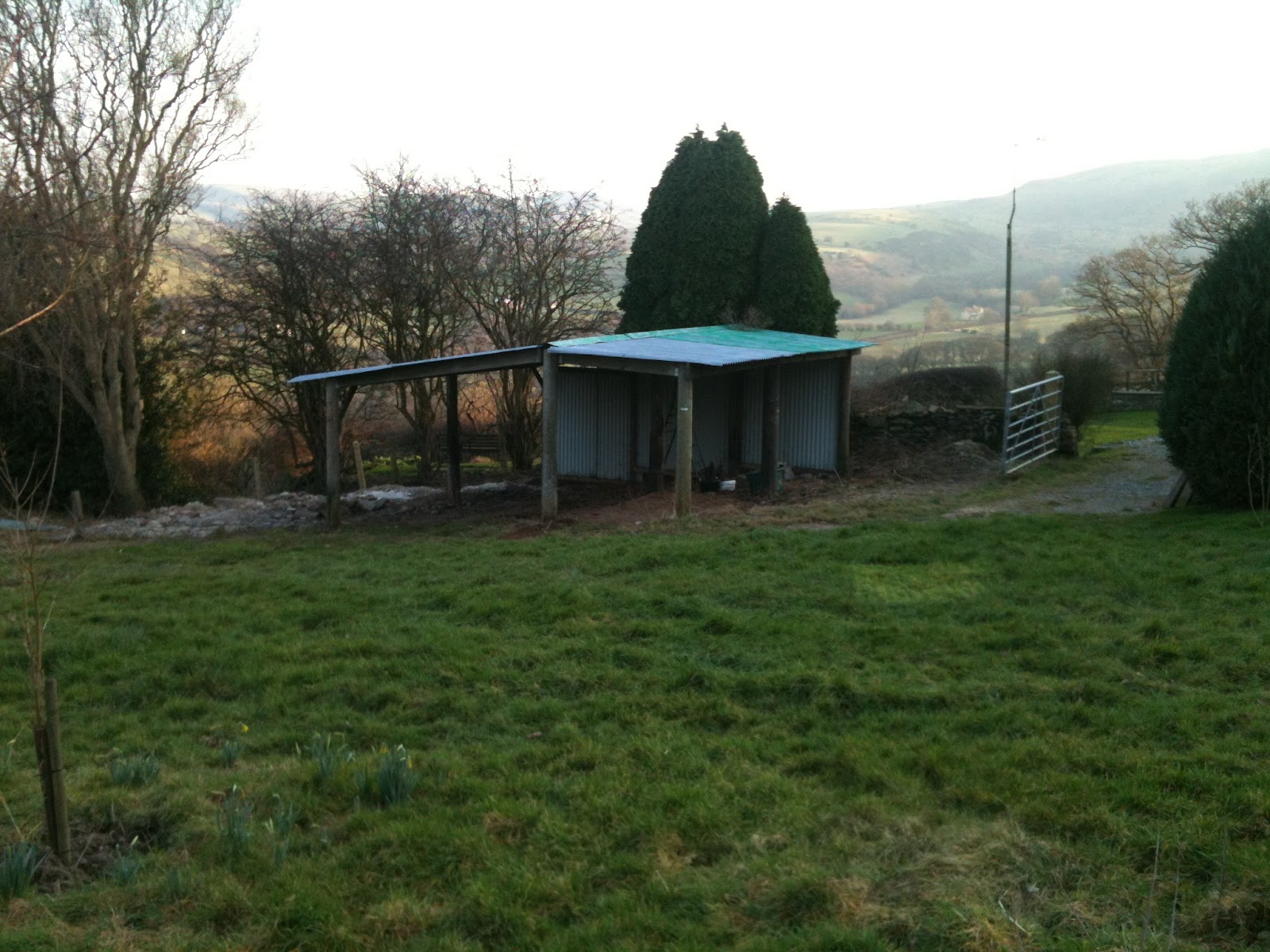
We shall soon have a new and bigger store for our horticultural and automotive pursuits.  The old telegraph-pole-and-corrugated-metal open barn is now empty (after quite a few days of work) and sits ready for the demolition gang:


Yesterday's efforts included moving the trailer, lawn tractor, Super Dexta tractor (1964 vintage), topper and finger mower (the last not having moved in our time here) up to the top of the field from where they will observe both a magnificent view of the Clywdian Range and the work of Lloyds as they construct a new two-part steel storage shed over the coming weeks.  Fortunately the intensive programme of battery charging paid off and, with only a minor hitch with the tractor hydraulics, we were there:


So, the electrics are disconnected, the trees are pruned and we are ready on schedule.  Bring on the builders!

Monday, 27 February 2012

A new aerial mast

When the former owners of these properties designed our holiday cottage, Gwenoldy, and had it created from the former stable and forge, they wisely chose not to affix a television aerial to the building.  And, as there was no loft space in which to hid the antenna, they ran the lead underground for thirty yards and put the aerial on the corner of the postbarn, home of the 1964 Fordson Super Dexta tractor.

In a couple of weeks the postbarn will be demolished and replaced by an enclosed 'implements store', approved by the planners to support our horticultural activities.  This will be a largely steel construction, but it has been designed in two sections to deal with the sloping site and mimic the construction of the original bakehouse and pigsties on the other side of the horseshoe-shaped 'courtyard'.  It's going to be constructed and erected for us by a firm which specialises in agrictultural buildings.

In the meantime, however, there is the minor issue of maintaining the TV signal to the cottage. From our track we can see the Moel y Parc transmission tower, all 850 feet of it.


This carries, amongst other things, TV and radio signals for North East Wales, and clearly had to act as inspiration for my temporary structure (our aerial will go back in due course on the new outbuilding).

So on Saturday the workshop was raided for bolts, the recycled woodpile for posts, and, with the use of both the post rammer (beast) and the maul (slightly less of a beast) our stony soil was penetrated to provide a firm foundation for our mast - all 25 feet of it.


Yes, I know, it looks like the kind of flagpole scouts (used to?) erect at camp.  Not quite in keeping with our luxury, 5-star cottage.  I agree, but it is only temporary, and do you have any better ideas?